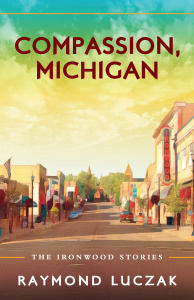
 One of the most prolific writers and editors of his generation, Raymond Luczak’s Compassion, Michigan is the latest collection of stories and it does not disappoint. As many people in the world today discuss the meanings, import, and relevance of intersectional identities and politics—and, especially as we consider the fact that experiences of marginalization and disenfranchisement can co-exist with privilege, in some cases—disability literature and the arts offer a broad range of readers and engages many and varied opportunities to address our individualized and collective ways forward. Luczak’s Compassion, Michigan: The Ironwood Stories is an understated tour de force, in these and other respects.
A tale may begin with a Carson McCullers-style injury, or even a Truman Capote-esque disappointment, and, by the story’s end, the protagonist’s queerness, disablement, and family dynamics have coalesced into learnings and transformation, inasmuch as their affective inner landscapes may have unraveled—at least at first.
A good story must of course sustain one’s attention; surely, if a story is too polemical, there is a risk of losing one’s audience. In these stories, as with his other work, Luczak engages astutely with an unwavering CripLit sensibility, throughout, while readers who are not necessarily interested in disability poetics (let alone attuned to them) are offered a nuanced and subtle education.
There are many lines among these stories’ inter-weavings that are as specific as they are unforgettable; these lines are often also full of surprises. Playfulness co-mingles with reserve and risk, as well, as if teasing elders are passing down cherished and complicated familial histories. Nearly everyone—even the outsiders, usually—gets the in-jokes, on the back porch, after dinner.

Raymond Luczak, author of Compassion, Michigan
These are stories crafted by a poet, to be sure. One of my favorite examples—full of realism and metaphor, simultaneously—is in “Yoopers”: “I feel as if my bangs will catch fire as I lean down and lift the sheet of pasties out of the oven” (69), says the narrator, young Molly, who tells the reader these thoughts in private, rather than via the ongoing dialogue with her grandmother in the kitchen. The character is relatable; we come to know her.
Read the full review on Wordgathering
Raymond Luczak
Raymond Luczak grew up in Ironwood and Houghton, Michigan. He is the author and editor of 24 books, including Flannelwood (Red Hen Press), The Kinda Fella I Am (Reclamation Press), and the award-winning Men with Their Hands (Queer Mojo). His next title will be Once Upon a Twin (Gallaudet University Press). A ten-time Pushcart Prize nominee and an inaugural Zoeglossia Fellow, he lives in Minneapolis, Minnesota.
![Feet in the Waves [HC]](https://d2j6dbq0eux0bg.cloudfront.net/images/11280610/products/849917574/5891218040.jpg "Feet in the Waves [HC]")
![Feet in the Waves [PB]](https://d2j6dbq0eux0bg.cloudfront.net/images/11280610/products/848991430/5891218040.jpg "Feet in the Waves [PB]")
![Ironhood: Poems [HC]](https://d2j6dbq0eux0bg.cloudfront.net/images/11280610/products/784266443/5199059267.jpg "Ironhood: Poems [HC]")
![Ironhood: Poems [PB]](https://d2j6dbq0eux0bg.cloudfront.net/images/11280610/products/784269445/5199059267.jpg "Ironhood: Poems [PB]")
![Yooper Poetry [HC]](https://d2j6dbq0eux0bg.cloudfront.net/images/11280610/5038225965.jpg "Yooper Poetry [HC]")
![Yooper Poetry [PB]](https://d2j6dbq0eux0bg.cloudfront.net/images/11280610/5038225961.jpg "Yooper Poetry [PB]")

![Compassion, Michigan [HC]](https://d2j6dbq0eux0bg.cloudfront.net/images/11280610/5038225972.jpg "Compassion, Michigan [HC]")
![Compassion, Michigan [PB]](https://d2j6dbq0eux0bg.cloudfront.net/images/11280610/products/233465194/5038225957.jpg "Compassion, Michigan [PB]")